Pages

Monday, March 13, 2006

KATHMANDU FACES MAOISTS BLOCKADE

The blockade, to begin on Tuesday, will affect towns across Nepal, Maoists say. They aim to stop supplies reaching the city mainly through fear of reprisals.
Authorities say rebel tactics will fail and have urged people not to panic.
More than 13,000 people have died in Nepal since the rebels began fighting for a communist republic 10 years ago.
In February 2005, King Gyanendra sacked the multi-party government and seized direct control of the government.
Intimidation
The authorities say sufficient arrangements have been made to ensure security and a normal supply of goods.
Home Minister Kamal Thapa urged people to defy the rebels.

King Gyanendra seized direct powers in February 2004
A similar blockade two years ago did not seriously disrupt normal life in Kathmandu, with security escorts for supply vehicles.
Although there was no major shortage of essential items, market prices shot up.
The rebels normally block the supply of goods to and from cities and towns through intimidation and fear of reprisal.
They are not physically present on roads to enforce the blockade, but are known to place road barriers in some places.
Mainstream political parties, who last year reached an understanding with the rebels to intensify pressure on the king, have urged the rebels to withdraw the planned blockade.
Human rights groups and civil society leaders have also made a similar appeal. They said the blockade would affect ordinary people more than the government.
The rebels have not responded yet.

TWO MAOISTS LEADERS LAUNCH REBELLIAN AGAINST TWO SENOIRMOST CPN(M) LEADRES

Within months of the patch-up between two seniormost leaders of the CPN (Maoist), two central committee members of the underground outfit have publicly criticized party supremo Prachanda, and no. 2 in the party, Dr. Baburam Bhattarai, alleging that they acts showcase what they called “non-proletarian tendencies.”
In a joint statement issued on Monday, central committee members of the CPN (Maoist) Rabindra Shrestha and Comrade Anukul have leveled personal and ideological allegations against party chairman Prachanda alias Pushpa Kamal Dahal and Dr. Bhattarai.
In their statement issued on behalf of the little known “New Cultural Revolutionary Group,” Shrestha and Anukul (believed to be central committee member Mani Thapa) narrated how ideological, political, organizational, military and cultural deflections had taken place among two top leaders of the party.
Referring to the public war of words between Prachanda and Bhattarai, the two central committee members said both of them had nearly pushed the party on the verge of vertical split. They also criticized party supreme, Prachanda’s statement in an exclusive interview with Kantipur daily. In his interview, Prachanda had said that his party would accept the outcome of the constituent assembly elections even if the majority of the people delivered their verdict in favour of monarchy or active monarchy.
Dr. Baburam Bhattarai (File Photo)
They have also alleged both Prachanda and Bhattarai of living in he safety of “foreign land” for eight out of ten years of the Maoist ‘people’s war.”
The unusual public criticism of the two top leaders from within the Maoist party has come just within weeks of the completion of ten years of the Maoist “people’s war.”
Shrestha and Thapa have also alleged Prachanda and Dr. Bhattarai of not sending their children in the frontline of the rebellion. They have also called upon what they called “new generation” within the party to carry out “revolution within revolution” in a new way.
There has been no official reaction to the latest statement by the two dissident leaders from the CPN (Maoist) leadership as yet.

GOVERNMENT HAS MADE ARRANGEMENT TO THWART BLOCKADES AND STRIKES

Maoists has called long blockades nad strikes from chhaitra 1st . Home Minister Kamal Thapa has said the government has made strong and adequate security provisions to thwart programs such as blockades and strikes.
Speaking at a program in the western town of Bhairahawa Sunday, the Home Minister called upon transport entrepreneurs and businessmen to help foil such blockades and strikes imposed upon the people.
At the same time, he also warned of strong action those defying the appeal.
He also informed that mechanism was already in place to ensure smooth and uninterrupted supply of commodities, according to reports.
The Home Ministers' comment came ahead of the rumours of indefinite blockade called by the Maoists starting from Tuesday.
Speaking at the same programme, entrepreneurs also urged all concerned parties not to organise such programmes saying it will have serious adverse impact in the national economy.

Saturday, March 11, 2006

SEVEN PARTIES HOLDING TALKS WITH MAOISTS LEADERS

Leaders of seven agitating political parties have said that they were holding talks with the Maoists to fine-tune the 12-point understanding and encourage them to call off blockades and the general strike they have called and declare an unilateral truce.
“We are engaged in talks with the Maoists to encourage them to call off the blockade and nationwide strike and effectively implement the 12-point understanding reached with the alliance. The talks are being held at various stages,” reports quoted CPN-UML standing committee member Bharat Mohan Adhikari as saying.
Adhikari, who met visiting US Principal Deputy Assistant Secretary of State for South Asian Affairs, Donald Camp, thanked the US for extending solidarity with the alliance’s peaceful movement which would gain momentum in the second week of April.
Nepali Congress leader Arjun Narsingh KC, who also met Camp, said he told the US official that Nepal would not return to democracy and peace would not be restored without bringing the Maoists into peaceful politics.
“I told Camp that the alliance will be able to bring the Maoists into peaceful politics through the 12-point understanding and that it is not possible for the rebels to impose a communist dictatorship given the country’s geo-political situation,” KC said.
KC also urged the Maoists to stop all the programmes that affect the people.
Leader of the Nepali Congress (Democratic), Dr Narayan Khadka, said Camp came here to convey US president George Bush’s message to the King, but the monarch is learnt to have told Camp that he would announce a date for general elections.
Leader of Nepal Sadbhavana Party (Anandi), Sarita Giri, said the alliance must be able to convince the US and other countries that the 12-point pact was good. “If we walk out of the pact, more bloodshed cannot be ruled out,” she said.
The US has expressed dissatisfaction over the 12-point pact between Maoists and political parties reached in November and said consensus between the King and political parties is a must to resolve the problems dogging the country and to tackle Maoist insurgency

LITTLE BUDDHA REPORTED MISSING

Ram Bomjan—a 16-year-old boy described as “little Buddha” who was meditating in a forest at Ratanpuri in the southern district of Bara for the last ten months—has been reported as missing since Saturday morning.
Latest reports say Bomjan may have shifted to another location deep inside the forest away from hustle and bustle at the place where he was meditating since early last year.
Ram Lama, member secretary of the committee that manages hundreds of devotees who visit the Ratnapuri to have “darshan” of the young boy, said he did not have any idea where Bomjan may have left. He, however, dismissed reports saying that Bomjan may have been abducted.
“He has left along with one of his colleagues. He must have gone in search of a quieter place,” radio reports quoted Lama as saying.
Meanwhile, police in Bara district said they had launched a search to locate Mr. Bomjan.

NASA'S CASSINI DISCOVERS POTENTIAL LIQUID WATER ON ENCELADUS

NASA's Cassini spacecraft may have found evidence of liquid water reservoirs that erupt in Yellowstone-like geysers on Saturn's moon Enceladus. The rare occurrence of liquid water so near the surface raises many new questions about the mysterious moon. "We realize that this is a radical conclusion -- that we may have evidence for liquid water within a body so small and so cold," said Dr. Carolyn Porco, Cassini imaging team leader at Space Science Institute, Boulder, Colo. "However, if we are right, we have significantly broadened the diversity of solar system environments where we might possibly have conditions suitable for living organisms."High-resolution Cassini images show icy jets and towering plumes ejecting large quantities of particles at high speed. Scientists examined several models to explain the process. They ruled out the idea that the particles are produced by or blown off the moon's surface by vapor created when warm water ice converts to a gas. Instead, scientists have found evidence for a much more exciting possibility -- the jets might be erupting from near-surface pockets of liquid water above 0 degrees Celsius (32 degrees Fahrenheit), like cold versions of the Old Faithful geyser in Yellowstone.

Spray Above Enceladus III
Mission scientists report these and other Enceladus findings in this week's issue of Science."We previously knew of at most three places where active volcanism exists: Jupiter's moon Io, Earth, and possibly Neptune's moon Triton. Cassini changed all that, making Enceladus the latest member of this very exclusive club, and one of the most exciting places in the solar system," said Dr. John Spencer, Cassini scientist, Southwest Research Institute, Boulder, Colo."Other moons in the solar system have liquid-water oceans covered by kilometers of icy crust," said Dr. Andrew Ingersoll, imaging team member and atmospheric scientist at the California Institute of Technology, Pasadena, Calif. "What's different here is that pockets of liquid water may be no more than tens of meters below the surface." Other unexplained oddities now make sense. "As Cassini approached Saturn, we discovered that the Saturnian system is filled with oxygen atoms. At the time we had no idea where the oxygen was coming from," said Dr. Candy Hansen, Cassini scientist at NASA's Jet Propulsion Laboratory in Pasadena. "Now we know that Enceladus is spewing out water molecules, which break down into oxygen and hydrogen."

Enceladus "Cold Geyser" Model
Scientists are also seeing variability at Enceladus. "Even when Cassini is not flying close to Enceladus, we can detect that the plume's activity has been changing through its varying effects on the soup of electrically-charged particles that flow past the moon," said Dr. Geraint H. Jones, Cassini scientist, magnetospheric imaging instrument, Max Planck Institute for Solar System Research, Katlenburg-Lindau, Germany. Scientists still have many questions. Why is Enceladus currently so active? Are other sites on Enceladus active? Might this activity have been continuous enough over the moon's history for life to have had a chance to take hold in the moon's interior? "Our search for liquid water has taken a new turn. The type of evidence for liquid water on Enceladus is very different from what we've seen at Jupiter's moon Europa. On Europa the evidence from surface geological features points to an internal ocean. On Enceladus the evidence is direct observation of water vapor venting from sources close to the surface," said Dr. Peter Thomas, Cassini imaging scientist, Cornell University, Ithaca, N.Y.In the spring of 2008, scientists will get another chance to look at Enceladus when Cassini flies within 350 kilometers (approximately 220 miles), but much work remains after Cassini¿s four-year prime mission is over.

Searching for Warmth
"There's no question that, along with the moon Titan, Enceladus should be a very high priority for us. Saturn has given us two exciting worlds to explore," said Dr. Jonathan Lunine, Cassini interdisciplinary scientist, University of Arizona, Tucson, Ariz.The Cassini-Huygens mission is a cooperative project of NASA, the European Space Agency and the Italian Space Agency. JPL, a division of the Caltech, manages the mission for NASA's Science Mission Directorate. The Cassini orbiter was designed, developed and assembled at JPL.

Thursday, March 09, 2006

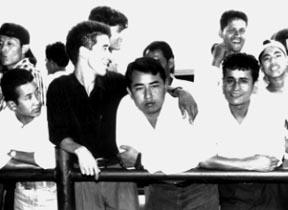
Throughout history, young people have helped bring social and political change. In Nepal, the People's Movement of 1951 and again in 1990, it was students who helped give power to the people through a system of multiparty democracy.
The campuses are once more in ferment after the royal takeover. The student wings of various political parties are again at the forefront of the struggle to restore democracy. But while many political factions in government colleges protest and demonstrate, a large number of students in private institutions are not as active.
Before the municipal elections in early February, the students of Amrit Science Campus in Lainchor were pelting stones and shouting slogans to protest the February First move while students from neighbouring private colleges, NIST and Kanya Campus, stood watching the demonstrations. Ironically, the onlookers outnumbered the demonstrators. The scenario was much the same all over the capital. A majority of private college students remain aloof. Does this mean that these young people are unaware of the country's political status? "I wouldn't say we are unaware or ignorant. We know what's going on, we just don't think pelting stones or vandalising public property is the way to do it," says Pratikshya Regmi of Institute of Advanced Centre for Education and Research. Politics has become the topic of many conversations as the 10-year conflict drags on. "During breaks, we discuss politics as we realise it affects our lives directly," adds Regmi, "we even had to write a paper on the failure of municipal polls, which is something that wouldn't have happened a few years back."
Girls of Padma Kanya Campus carrying an effigy to symbolise regression in a funeral procession.The urban youth are aware of the Maoist conflict and though some think that politics isn't a matter of their concern, they are starting to understand that it directly affects their lives. Most of them are too young to remember the details of the Panchayat era but when on 1 February 2005, telephone and Internet services went suddenly dead, they knew that certain rights had been seized. What these young people still fail to grasp is that if problems are not addressed, they will continue to grow.
However, the silent majority of students frown upon enforced bandas, burning tyres, scrawling slogans and destroying public property. They don't think the end justifies the means. In fact, such violence and vandalism are the reasons why private college students have remained distant and disillusioned with the 12 years of multiparty democracy. What the difference in opinions between students of private and public colleges does expose, however, could be class. The privileged are more in favour of the status quo.
"The new generation does not look at what we gained after 1990, these gains outweigh the corruption and the instability of that period," says student leader Gagan Thapa, who is among the few well-educated individuals to enter Nepali politics. "We have not been able to reach students in private institutions. There is no dialogue. We need to listen to them and share our views." Thapa, who led many destructive protest programmes in colleges, has now changed his stance as he says, "Burning effigies and throwing stones got us nowhere. Peaceful protests are more effective and appeal to the majority."
More than half of the 9 million young Nepalis are students. About 1,50,000 attend private colleges while an estimated 3,00,000 attend government colleges. There are no political student affiliations in private colleges. Though the eight student organisations in Nepal claim to have the participation of 6,00,000 students, only 2,00,000 students of Tribhuvan University affiliated colleges are actively involved.

silent protest against media censorship after 1 February.The abduction and torture of students by Maoists three years ago prompted Sandesh Adhikari, Dipendra Tamang, Urmila Thapaliya, Ajay Babu Shivakoti, Subodh Acharya and friends to start Alliance For Peace (AFP). They report to the Human Rights Commission and United Nations about abduction and detention of students in Nepal. "There's no need to go to the streets. We contribute whatever we can," says Sandesh Adhikari of AFP. About the plus-two generation, he adds, "They prioritise their studies and careers, and are disinterested in politics. They are always looking to fly abroad but I believe they can be made politically aware through education."
Private institutes might not have political student organisations but they do have student councils and alumni associations. AFP's Dipendra Tamang says, "Few councils and alumni associations raise issues of Humla, Jumla or Ratna Park. They concentrate on fashion shows, dance parties, and picnics. Young people are taught that politics is a dirty game. Most don't expect to live in Nepal forever."
When they do go abroad, many Nepali students hunger for news from home. "I'm always reading up on news and following the events in the country. Every night I log on to nepalnews.com and other Nepali news sites to find out what's happening," says Rajan Adhikari, who's studying at a university in California. He adds, "When we meet other Nepalis, we always ask for news from home. We weren't as aware of politics in Nepal as we are now."
A college girl plastering posters in the run-up to student elections.According to AFP records, not one percent of the urban young are involved in protest programmes. Pashupati Campus is the only private college in Kathmandu whose students take to the streets in pro-republic programmes. "Even if we are interested in political goings-on, we've heard of various parties using students for selfish purposes, even paying them to stage protests, which is a turn-off," says Srijana Limbu, who studies in Kathmandu University School of Management.
Lack of political interest in private college students is also because they are very career-focussed. Abhinav Baidya, an Apex College graduate who's looking for a job, says, "I don't want my investment in studies to go to waste. Most students want to fly abroad so why bother with politics? Our focus is on building a career."
Yubaraj Khatiwada of Nepal Commerce Campus believes that if student organisations could reach such students, politics in Nepal could have a better chance. He adds, "Career-focussed students should understand that if the political situation of the country is not stable and the economy continues to plummet, their dreams of a career could be in jeopardy."
Young engineers throwing stones to protest the hike in fuel prices.A classic example of the great divide is the eight student organisations' demonstration staged three years ago against expensive tuition fees in private educational institutions. The students of private colleges resented their demands saying the protests had disrupted their studies. Many colleges even make students and their parents sign application forms agreeing not to get involved in political activities within the college. Contrary to this, in government colleges, students themselves initiate and arrange political programmes.
Today, as Nepali TV serials with political satire grow popular, even high school students are beginning to ask about democracy, republicanism, and monarchy. Akhil Nepal National Free Students Union's (ANNFSU) president Khim Lal Bhattarai believes that sooner or later the young generation will join the campaign for a republic. But ANNFSU admits to being unable to spread into private colleges. Bhattarai adds, "Even then, the majority of protestors today are students, which is a good sign. Many young people still doubt politicians."
Nepal Students Union president Pradip Paudel says that only political awareness and action can change the country's political situation. "If we don't care about the country's future, who will?" he asks, "It is up to us to make sure that tomorrow's leaders are good enough. To remain silent is a weakness and a breach of your own rights."
Nursing students show their solidarity for democracy at a protest programme.Akhil's female leader Ram Kumari Jhankri agrees with Bhattarai. "You can't say 'I have what I want so why bother about others'," she adds. Binita Adhikari, chairperson of Padma Kanya Campus' Free Students Union agrees, and says awareness is the key. "All the students in our campus might not join the street protests but they raise their voices when they can," says Adhikari, "they are free to choose when and how to act. As students, if you are really future-focussed, politics could help make a difference. You might lose two years of study but you will have a future of 200 better years."
Street protests aren't the only way to participate in politics. Sarahana Shrestha went to the US to study computer graphics four years ago. She wasn't concerned about politics then, now, she runs samudaya.org. She started the website after 1 February 2005 to create a platform for Nepalis all over the world to express their views. A few months later, it was banned by the state along with a few other pro-democracy sites.
Says Shrestha: "Politics plays a major role in our future, many don't understand this. We don't support the Maoists, rather we've been criticising those who go against democracy." Samudaya.org can still be viewed through mirror sites like http://www.everybodybreed.com/. A multimedia designer for Greater Than One Interactive Online in New York, Sarahana devotes whatever time she has between schedules to raise awareness about politics among young Nepalis. Her latest is a T-shirt campaign with the slogan 'Naya Nepal Sambhab Chha'.
THE EIGHT STUDENT ORGANISATIONS
All Nepal National Free Students Union (CPN-UML)Established: 13 April 1965President: Khim Lal Bhattarai Total members: 5 lakhs (Male:Female – 62:38 percent)Structure: 75 districts (61 government, 200 private colleges; active in universities)
Nepal Student Union (Nepali Congress)Established: 19 April 1970President: Mahendra SharmaTotal members: 6 lakh (Male:Female – no records)Structure: 75 districts (61 government, 200 private colleges; active in high schools in Nepal, India, and the US)
Nepal Student Union (Democratic)Established 19 April 1970President: Kishor Singh RathoreTotal members: 7 lakh (Male:Female – no records)Structure: 75 districts (61 government, 200 private colleges; active in high schools in Nepal, India, and the US)
All Nepal National Free Students Union (CPN-ML)Established: 13 April 1965President: Bhim RaiTotal members: 2.5 lakhs (Male:Female – 60:40 percent)Structure: 62 districts (61 government, 200 private colleges; active in high schools in 50 districts of Nepal)
All Nepal National Free Students Union, United (Peoples Front Nepal)Established: ANNFSU on 13 April 1965, ANNFSU United in 2002President: Krishna AdhikariTotal members: 6 lakhs (Male:Female – 70:30 percent)Structure: 68 districts (50 government colleges; active in 68 district high schools)
Nepal Progressive Students Union (CPN, Marxist)President: RajuTotal members: 6 lakhs (Male:Female – 70:30 percent)
Nepal Revolutionary Students Association (Peasants and Workers Party)Established: 1969President: Saroj Raj GosainTotal members: Data unavailable
Nepal Students Forum (Nepal Sadbhabana Party, Anandi Devi)Established: 11 August 1990President: Ram Babu YadavTotal members: Data unavailableStructure: 22 districts (12 government colleges; active in all districts in Terai)
STUDENT MILESTONES IN NEPALI HISTORY

A young man raises his hands from the statue of Prithivi Bir Bikram Shah in front of Singha Darbar on 6 April 1990, hours before King Birendra gave up direct rule.1951: Young Nepalis help end 104 years of Rana Regime. The protest gains momentum after students of Tin Dhara Paatshala declare Jayatu Sansritam.
1961: King Mahendra's coup ends democracy and brings in 30 years of partyless Panchyat. The regime creates a pro-government student union (called 'Mandales') to marginalise party-affiliated pro-democracy students.
1980: Student-led protests force King Birendra to announce a referendum on democracy. The people vote for a reformed Panchayat system.
1990: Students actively participate in the People's Movement in the streets that snowballed, forcing King Birendra to unban the parties and give up his absolute powers.

SECURITY FORCES,REBELS CLASH IN ILAM

Reports say there have been heavy clashes between the security forces and Maoist rebels at Danabari area bordering Ilam and Jhapa district from Thursday afternoon.
Security sources in eastern town of Itahari said clashes took place after the security forces pursuing the rebels who had attacked Ilam headquarters on Sunday came across the rebels.
Rebels have claimed that there have been a number of casualty on the part of the security personnel during today’s clashes. They claimed that they have also seized weapons from the security personnel.
Security officials said injured security personnel have been airlifted for treatment. They said a number of rebels were also killed during the clashes.
Details are still being awaited.
Over a dozen people including three security personnel, two civilians and eight rebels were killed during overnight clashes in Ilam on Sunday

FIVE MAOISTS KILLED IN RAUTAHAT CLASH; OVER 1500 VILLAGERS ABDUCTED IN RUKKUM

Reports say there have been heavy clashes between the security forces and Maoist rebels at Danabari area bordering Ilam and Jhapa district from Thursday afternoon.
Security sources in eastern town of Itahari said clashes took place after the security forces pursuing the rebels who had attacked Ilam headquarters on Sunday came across the rebels.
Rebels have claimed that there have been a number of casualty on the part of the security personnel during today’s clashes. They claimed that they have also seized weapons from the security personnel.
Security officials said injured security personnel have been airlifted for treatment. They said a number of rebels were also killed during the clashes.
Details are still being awaited.
Over a dozen people including three security personnel, two civilians and eight rebels were killed during overnight clashes in Ilam on Sunday

Tuesday, March 07, 2006

NEPLESE IN ABROAD.........IN SEARCH OF PROSPORITY

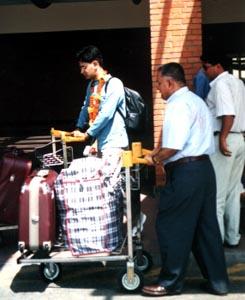
Never in the history of the country have Nepalese been going abroad in such large numbers as migrant workers, students or for other purposes. Isolated from the outside world for long and because of restrictions on foreign travel, Nepalese were confined within their own borders. The situation has changed, especially in the last decade. Nepalese working overseas are helping their country's tottering economy, but not without enduring immense psychological and social trauma themselves.
Four-year-old Nirmala Shrestha (not her real name) does not know what her father look likes. He went to the United States just a few weeks after he got married. Nirmala's family is not certain whether he would ever return to the country.
"I talk with my husband on the phone, but that kind of contact is not enough for our daughter to recognize him," says Nirmala's mother, Geeta Shrestha, 24. "I know he will return, but I can't give a date."

Subarna Subedi (not his real name), an eight-year-old boy, is equally desperate to see his father, who left for the United Kingdom when he was just three months old. Subarna talks to him on the telephone, but that is hardly a consolation. "My father will return within the next few months, and I will never allow him to go to a foreign country again," says Subedi, wearing an innocent smile.
Subarna's mother, however, has other dreams. She is certain that her husband will ask them to join him in Britain as soon as he gets legal permission to live and work there. "We have to face difficulties to see a better and prosperous future," says 28-year-old Bunu Subedi.
Subarna and Nirmala are merely two of countless Nepalese children who are living with a single parent. The other parent is in United States, United Kingdom, Belgium, Germany, Japan, South Korea and Malaysia, Singapore, Hong Kong and Gulf countries toiling hour after hour in the quest of a secure and prosperous future.
Often, that turns out to be an elusive quest. One has to spend thousands of rupees to buy the plane ticket, get a passport and visa. Those who have been travelling with illegal documents and living illegally could end up facing a more difficult time in the country of destination.
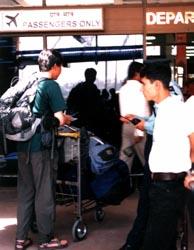
Rameshwor Kanu, Jeet Limbu and Ghanshyam KC were flown back to Kathmandu from New Delhi's Indira Gandhi International Airport because they were carrying unconfirmed tickets to Dubai. Although Kanu, Limbu and K.C. had already acquired the work permit and visa to go to Dubai, they were forced to return because their tickets for the connecting flight to the Gulf emirate were not confirmed.
"Who will compensate the money we spent flying from Kathmandu to New Delhi and back?" asks Kanu, who had taken a loan on his land and property. Kanu, Lama and Limbu, hoping to escape the desperate poverty of their families, succumbed to the promises of a conman posing as a government agent. For the residents of a dirt-poor town, the benefits from working abroad were simply too good to ignore. After a few weeks of training, the man told them, they would be making a healthy US$ 250 a month working in a factory.
Jeevan Lama, 28, (not his real name) was immediately flown back to Kathmandu when Air Canada staff at Indira Ganndhi International Airport discovered that his immigration visa was fake. After inquiry, authorities found that the official passport he was carrying was not his own.
Although the personal stories and family trauma of migrant workers vary from country to country, there is a common thread: Tens of thousand of migrant workers leaving Nepal in search of work abroad. Aspirants spend huge amounts of money in trying their lock. Ignorance of international immigration regulations and rules of the travel system often land many into instant trouble. Kanu, Limbu and KC were victims of unscrupulous travel agents and a manpower company.
"We have to settle a couple of such cases of deportation and complications of tickets of Nepalese workers," said an official at Royal Nepal Airline's New Delhi office. "In most cases, Nepalese migrants are compelled to return because they carry unconfirmed tickets for connecting flights."
Tickets, passport and visa alone are not enough for one to head on the road to prosperity. It is important to establish whether these documents are original. Many Nepalese have been facing trouble flying without knowing the legal status of their airline tickets and passports.
According to a recent report of the Department of Labor, more than 214,839 Nepalese are working in East Asia, South East Asia and the Gulf region. There are 77,686 legal Nepalese workers in Saudi Arabia, 52,581 in Malaysia, 48,869 in Qatar, 23,321 in the United Arab Emirates (of which Dubai is a part), 3,040 in South Korea, 2,929 in Bahrain, 2,821 in Kuwait, 1,639 in Hong Kong and 1,953 in other countries. An equal number of Nepalese are working abroad illegally.
In Europe and the United States, most of the Nepalese migrant workers are well educated. From a former chief editor of Nepal's oldest daily newspaper to prominent actors, countless Nepalese are living and working in the United States illegally. In the United Kingdom and other European countries, too, Nepalese workers have similar academic qualifications.
"Given the distances involved and the difficulties of access for other reasons, migration to North America (to a lesser extent Europe) is generally limited to those with both resources and qualifications," according to a study conducted in 1999 by David Seddon, with Jagannath Adhikari and Ganesh Gurung, for the British government's Department for International Development (DFID).
According to the report, there are some 30,000 illegal Nepalese migrant workers in East and South East Asia, of which possibly 10,000 are in Japan, where most aspire to work because of the high wage rates available even for menial jobs.
"Once a visa's validity expires, the people have a choice: either to surrender to the immigration officials or to stay as much as possible to make money," says advocate Gandhi Pandit, who has practised immigration law in New York.
Hundreds of migrant workers are on the move in Asia, seeking work but finding only frustration and abuse. The stories of affluence and facilities migrant workers are enjoying in such countries sound too good to be true. In many cases, they are.
History of Migration
A large number of Nepalese workers go abroad to work in the absence of fruitful local employment opportunities at home. After the Nepal-British war of 1814-1815, the formal entrance of Nepalese citizens in foreign employment begun when 4,650 Nepalese were appointed to the British armed forces as part of the British-Gurkha regiment. Also a large number of Nepalese workers had migrated to Myanmar and Assam in North-east India.
Youth : Plagued by unemployment
Today the government has permitted 20 countries to recruit Nepalese workers. Those countries include Qatar, Saudi Arabia, the U.A.E, Oman, Kuwait, Bahrain, Malaysia, Singapore, Hong Kong (China), South Korea, Brunei, Saipan (US), Iraq, Macao (China), Israel, Kosovo and South Africa. According to the Ministry of Labor, permission has also been issued to the Maldives, Latvia and Seychelles. Statistics of the Ministry of Labor also show that there are 45 in the United States, 53 in England, 12 in France and three in Germany.
The British Gurkhas are still regarded as the best source of foreign employment for Nepalese. The Gurkha soldiers receive many legal facilities during their tenure in the regiment. Their employment and other facilities are guaranteed under a treaty between Nepal, United Kingdom and India.
Although Nepalese started joining foreign army a long time back, the soldiers returned as soon as they were retired. This is why only a few Nepalese families are settled outside the country.
The phenomenon of Nepalese migrating to other countries is very new. About 100,000 Nepalese are estimated to have immigrated to the United States, Australia, Canada, United Kingdom and other European countries.
The upsurge of Nepalese going abroad begun after the restoration of multiparty democracy in 1990 when the distribution of passports was relaxed and many foreign employment companies were set up.
Trauma of Workers
Hoping to secure prosperity by working in foreign lands, many Nepalese are fleeing their from their homeland with whatever documents they can get. From the educated to the barely literate, there is an irresistible lure to go overseas for work. In many cases, people with illegal documents land in police custody and are compelled to spend their life in foreign prison.
According to a conservative estimate, up to 1,000 Nepalese who were trying to enter other countries illegally are serving prison time in different parts of the world. Most of the illegal workers are prisoners are in Southeast Asian countries. Had Puri and Lama been detained in the capital of any East Asian country, they would have had to face harsh prison terms, from 10 years to life.
From Europe to North America and from South East Asia, East Asia to the Middle East, Nepalese are going in search of work in growing numbers each year. Mostly illiterate and unskilled workers prefer to go to South East Asia, India and the Middle East, whereas educated groups of people prefer to migrate to Western Europe, the United States and Japan.
Whether literate or educated, the majority of the Nepalese do similar works. In the United States, Western Europe and Japan, illegal Nepalese workers have been working in restaurants, gas stations and construction companies, like their literate brethren in the Middle East and East Asia.
Because of lack of skills, the majority of Nepalese residing in the United States and Western Europe do not find better positions than those held by nationals of South and East Asian countries.
Cultural Crisis
If they had been aware of the legal and other complications they would have to face in day-to-day life after the expiry of their legal rights to stay in the country, most people would probably have opted to return home. "I know life in Nepal is not easy, but I have friends and families there. After all, I have recognition and prestige," says a prominent Nepalese who got a US green card after living in the country illegally for more than five years.
As migrant workers' salary and work are based on their skills, they have to be prepared to do every kind of work, including those they would shun in Nepal. Once they return home, migrant workers also bring along skills and work ethics. The exposure Nepalese workers get in foreign countries can be immensely beneficial to Nepal.
Illegal Workers
Even some very educated Nepalese have been working in Britain, United States and Japan as illegal workers. In the United States and Britain, undocumented Nepalese are found working either in gas stations or in restaurants. Hundreds of Nepalese from all backgrounds and age groups are engaged in menial work in the United States.
Few Nepalese are aware of the difficulties that await them abroad. The fortunes of legal migrants are affected by job market conditions. Many have to confront growing anti-immigrant sentiment from resurgent far-right political groups. Whether in the United States, Malaysia, Japan or any other part of the world, illegal workers face additional hardships in the form of exploitative employers and unpleasant brushes with the law.In South East Asian and East Asian countries, once police arrest an illegal immigrant, he or she has to go to prison for life. Illegal immigration is regarded as a crime like murder. In Thailand, Malaysia and Singapore, many Nepalese are serving life imprisonment. As the country is in no position to afford legal counseling, many Nepalese caught with false documents are forced to go to jail.
Migrant workers have always reflected Asia's fortunes. They were globalization's prisoners. As the economic surged, host countries such as Japan, Korea, Malaysia and Thailand not only welcomed documented workers but also happily turned blind eye to illegal foreign workers who could help build their infrastructures. Life was tough but the migrants Nepalese, though on the bottom rung, were on the ladder to prosperity. These days, authorities treat foreign workers like pariahs.
Securing Employment
As it is easier to go through illegal channels, many Nepalese are unaware of legal complications that come with being trapped in the wrong side. According to the Ministry of Labor, only a few people going through duly registered manpower supply companies end up facing law-enforcement authorities abroad. But many Nepalese complain of being cheated by people claiming to be duly authorized representatives of Nepal's 234 manpower supply companies.
Before 1990, it was very difficult to secure a passport, so only a few people got the opportunity to go abroad.
"Access to employment abroad is regulated in a variety of ways, both formal and informal. The process of recruitment differs significantly, depending on the form of employment and the region to which the migrant workers go; the relative importance of personal networks and pre-existing linkages between place of origin and place of work also various considerably," according to Seddon's study.
Employment in the British Army depends on success in formal selection procedures usually at clearly identifiable recruitment centers. The Gulf is the most rapidly growing region for Nepalese migrant laborers. Benefits of the Foreign Employment
Despite the social and psychological trauma Nepalese worker undergo, the money they send back home has proved to be a boon to the Nepalese economy. According to Seddon's study, the value of remittances from migrant Nepalese workers could be as high as Rs. 69 billion. This would be the rough equivalent of 25 percent of official gross domestic product and about 20 percent of adjusted GDP.
Nepal Rastra Bank's 2000\2001 estimates showed that the amount is just Rs. 12.66 billion. "The DFID's report is based on an over-estimate," says a senior official at the central bank.
Innocent and unaware, Nepalese go abroad dreaming of a prosperous future. When they find themselves on the wrong side of the law, it is often too late. They end up as illegal workers from where they nether can return to unite with their family nor live with satisfaction. For children like Nirmala and Subarna, the psychological trauma can be lasting.

APOLLO ASTRONAUTS NOTICED SOMETING VERY STRANGE ABOUT SHADOWS ON THE MOON

The moon is utterly familiar. We see it all the time, in the blue sky during the day, among the stars and planets at night. Every child knows the outlines of the moon's lava seas: they trace the Man in the Moon or, sometimes, a Rabbit.
This familiarity goes beyond appearances. The moon is actually made of Earth. According to modern theories, the moon was born some 4.5 billion years ago when an oversized asteroid struck our planet. Material from Earth itself spun out into space and coalesced into our giant satellite.
Yet when Apollo astronauts stepped out onto this familiar piece of home, they discovered that it only seems familiar. From the electrically-charged dust at their feet to the inky-black skies above, the moon they explored was utterly alien.
Thirty years ago their strange experiences were as well-known to the public as the Man in the Moon. Not anymore. Many of the best tales of Apollo have faded with the passage of time. Even NASA personnel have forgotten some of them.
Now, with NASA going back to the moon in search of new tales and treasures, we revisit some of the old ones, with a series of Science@NASA stories called "Apollo Chronicles." This one, the first, explores the simple matter of shadows.
Dark Shadows
On the next sunny day, step outdoors and look inside your shadow. It's not very dark, is it? Grass, sidewalk, toes--whatever's in there, you can see quite well.
Your shadow's inner light comes from the sky. Molecules in Earth's atmosphere scatter sunlight (blue more than red) in all directions, and some of that light lands in your shadow. Look at your shadowed footprints on fresh sunlit snow: they are blue!
Without the blue sky, your shadow would be eerily dark, like a piece of night following you around. Weird. Yet that's exactly how it is on the Moon.
To visualize the experience of Apollo astronauts, imagine the sky turning completely and utterly black while the sun continues to glare. Your silhouette darkens, telling you "you're not on Earth anymore."
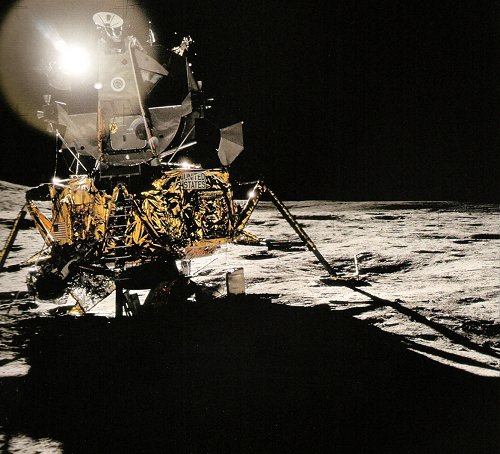
Shadows were one of the first things Apollo 11 astronaut Neil Armstrong mentioned when he stepped onto the surface of the moon. "It's quite dark here in the shadow [of the lunar module] and a little hard for me to see that I have good footing," he radioed to Earth.
The Eagle had touched down on the Sea of Tranquility with its external equipment locker, a stowage compartment called "MESA," in the shadow of the spacecraft. Although the sun was blazing down around them, Armstrong and Buzz Aldrin had to work in the dark to deploy their TV camera and various geology tools.

MAOISTS ABDUCT TEACHERS, GOVT OFFICIALS; TWO MINOR INJURED IN BLAST

Maoists have abducted two persons, one of them government official, in Doti district and four teachers in Sindhupalchowk.
A statement issued by the Ministry of Defence (MoD) said a group of Maoists abducted Dan Bahadur Karki, an overseer working at the District Development Committee of Doti and Netra Bahadur Bom, member of District Drinking Water Consumers’ Committee, on Tuesday.
Likewise, the rebels abducted four teachers of Sunkoshi Secondary School in Budepa area of Sindhupalchowk district last Thursday, according to the ministry.
On Friday, two children were injured when a bomb left behind by the Maoists went off in Rangsi area of mid-western Rolpa district.
Om Prakash Dangi, 8, and Noksiram Dangi, 11, were severely injured in the blast, the ministry said

EDUCATED YOUTH ARE RETURNING TO VILLAGES

At a time when thousands of youths are fleeing their villages in the wake of escalating conflict, a growing number of youths are returning to conflict-hit areas to help local communities in their local level development endeavours.
Samuhik Abhiyan, a non-governmental organization, is mobilizing youths in rural areas to support development activities of local communities.
Under its National Volunteer Mobilisation Programme (NVMP), Samuhik Abhiyan, has been mobilising fresh graduates to support development activities at the local level since 1997.
The Abhiyan has already mobilised 70 volunteers in different communities including in the conflict affected areas of the Mid-Western region.
To begin with, the SA selects candidates to join the NVMP from the local and national level. The volunteers play the role of social mobiliser in selected communities.
Working as volunteers, young men and women spend up to 18 months supporting the activities of the communities and making communities aware about their development needs and raising awareness about their rights.
The volunteers get only minimum remuneration for working in the communities. What motivates them to work in difficult situations at a very low remuneration is the respect of the community and result of their work.
Samuhik Abhiyan offers 15-day long training to volunteers before sending them to the field and provides them 45-day long training in course of their 18-month long stay with the communities.
“Thanks to the tireless works of our volunteers, people have become aware about their rights and development needs and are able to raise their voices with the concerned authorities, ” said Kapil Neupane, programme director of NVMP.
According to Neupane, Samuhik Abhiyan launched the programme without seeking funds from donors. “We don’t engage in development works directly. All we do is play a catalytic role for development by mobilizing volunteers,” he added.
So far, volunteers mobilized by the Samuhik Abhiyan have not had any trouble at the local level from the warring sides as they working with local communities without any political or other interests.
The NVMP has mobilized volunteers in 31 communities including some conflict-hit districts. In the fifth group, volunteers have been mobilized in 14 communities of nine districts.
“First, people did not believe that we could contribute in any way for the betterment of the society as we did not have any money or projects to offer to local people. But, slowly they realized our importance and started treating us as their own members,” said Divya Raj Acharya, who worked as volunteer among the Dalit community of Kailali in far- western region.
He advised that the programme should be extended and there should be some provision to fill in the gap after volunteers return after completing 18 months.
Due to their commitment for the betterment of the society, ex-volunteers have formed a Volunteers Forum, which is actively working for the continuity of the programme.
Impressed by the performance of volunteers, MS Nepal and Action Aid Nepal have been extending cooperation in NVMP from the fifth group.
The local community has to pay 9,000 rupees as participating fee and provide food and lodging facilities to the volunteers under this programme.
“Some communities are also demanding for the extension of volunteers even after 18 months and have also agreed to pay the cost for it,” Neupane added.
During the 1970s, the Tribhuvan University had launched the National Development Service (NDS), popularly known as Rastriya Bikas Sewa, under which all post graduate students were required to dedicate one year as part of their Masters degree studies to go and work in rural communities.
The NDS is considered by many of having a catalytic social development experiment in the life of the nation. In the opinion of some observers, the NDS was a highly successful students’ ‘volunteer’ program, and perhaps one of the most successful national programs in Nepal.
In 1973 and early 1974, 22 volunteers in two small trial projects were sent to live and work in rural communities. In July 1974, the NDS program was formally launched, and the first regular batch of 212 students (57 female, 155 male) was sent to the field.
From the beginning until the program was closed down five years later in 1979, a total of 3,063 students were enrolled and posted to the rural areas (of which nearly 21 percent were female).
Though the programme was very successful, it was closed in 1979 due to the fear that the student volunteers might persuade rural people to vote in favour of multi-party democracy against the then Panchayat polity. Officials, however, said NDS was closed due to funding problems.
Late King Birendra had called for a referendum between the Panchayat polity with reforms and multi-party democracy in 1980 in which the former was declared winner.
In 1998, amidst the phenomenal growth of Nepal’s civil society institutions, the National Planning Commission (NPC) members decided to revive the tradition of volunteerism and took initiative to launch a similar programme.
In the winter of 1999, the council of ministers approved a new volunteer program, the ‘National Development Volunteer Service (NDVS),’ which was launched formally in April 2000.
Local people involved in development activity of a village (nepalnews.com)
During 1998, a pilot program was inaugurated involving 220 volunteers posted in 25 hilly and mountain districts. Since then, the program has expanded to include 42 hilly, mountain and lowland (terai) districts.
By mid-2002, a total of 520 volunteers had been mobilized, most of whom were new graduates with technical skills in agriculture, engineering, solar energy and water management along with a smaller number of liberal arts, management and planning graduates, according to the NPC.
The National Volunteers Management Programme (NVMP) being implemented by Samuhik Abhiyan is not only complementing the NPC’s programme in its own way, it has also shattered the myth that today’s educated youth don’t want to return to villages once they graduate

PREPARATIONS ON FOR THE CAN INFO-TECH 2006

The Computer Association of Nepal (CAN) has informed that preparations are in full swing for the 12th CAN Info-Tech (2006) that will be held from March 23 to 28 at the Birendra International Convention Centre in Kathmandu.
CAN, the organiser of the mega IT event, informed that 110 different companies including four Indian companies working in the different fields of information and communication technology are participating in the exhibition.
Talking to Nepalnews, coordinator of the Info-Tech, CN Upadhaya, informed that the latest information and communication technology, hardware and newly developed software will be the main features of the exhibition.
He further said that the Info-Tech is aimed at promoting information and communication technology and disseminating information about the latest developments in the IT sector.
According to the information given by the CAN, SchoolNet-Japan is organising a two-day winter camp for schoolteachers to give information about the use of IT in the education sector. 100 teachers teaching at 10+2 will participate in the camp.
According to CAN, around 300 thousand visitors are expected during the Info-Tech. Over 230 thousand people had visited last year’s exhibition.
Nepalese Microsoft office system and Nepali computer software Nepalinux along with exhibition of teli-centres of rural areas and Nepali Pavilion will be some of the attractions of the exhibition,” a press statement issued by CAN said.
Altogether 38 experts including 17 foreigners of 10 countries will present working papers on the conference.
Discussions will be held in the topics including infrastructures for IT, development of software, e-commerce, bio-informatics, e-governance, the statement added.
The annual IT fair scheduled for January 25-30 in Kathmandu was postponed due to the political situation of the country.
The association has been organising the IT event annually since last the 12 years.

NATURALLY NEPAL....once is not enough!

The New Tourism Brand will be adopted by all the travel
trade and other concerned agencies that market Nepal nationally or internationally.
Minister of State for Culture, Tourism and Civil Aviation, Yankila Sherpa, unveiled the brand amidst a function the capital on Sunday.
The brand is also aimed at repositioning Nepal's image in the international tourism market. It incorporates a strategy to attract additional 300,000 tourists in Nepal in a year by making around Rs 100 million investment in tourism promotional campaigns.
Explaining the New Tourism Brand, Tek Bahadur Dangi- Chief Executive Officer of NTB said, “New Nepal Brand will be instrumental in increasing the number of tourists to Nepal. Prior to this campaign, we were solely dependant on the individual overseas tour operators to promote Nepal, but we will now all be working together in a concerted, focused and centralized effort to penetrate the new segment of consumer market that also has great potential.”
Dangi informed that the new Nepal brand was developed by Indian based social infrastructure agency Alchemy, which has plans to reinvent Nepal's diversity, modernity and cultural heritage to make the country a more popular tourism destination.
Dangi further said, “Three new tourism brand has evolved with three major segments: Weekends breaks, Adventure holidays and Lifetime experience.”
Weekend break deals specially for Indian markets and other regional markets due to their proximity and easy air connectivity and Adventure and Lifetime experience aims at long haul markets like USA, Europe, Australia and others.

Wednesday, March 01, 2006

ANTI GOVERNMENT STUDENT BODIES SWEEP THE FSU ELECTION

Student unions affiliated to seven political parties have won the election of Free Student union (FSU) in majority of campuses affiliated to Tribhuvan University and Mahendra Sanskrit University.
Vote counting is still going on in some campuses including Central Campus Kritipur.
In Kathmandu Valley, single panels of NSU candidates won the elections at five campuses and ANNFSU at three campuses. Mixed results came out in the rest of the campuses.
NSU candidates led by Sovit Shrestha at Public Youth Campus, by Tika Bhandari at Padma Kanya Campus, Santosh Pandey at Pashupati Campus and Matina Shrestha at Maharajgunj Nursing Campus were elected, according to reports.
Similarly, ANNFSU candidates led by Nawaraj Thapaliya at Nepal Law Campus and by Anil Thapa at Sanothimi Campus were elected.
Mixed results came out at Balmeeki and Lalit Kala campuses. Candidates of ANNFSU Sudarsan Dhungana at Balmeeki campus and LB Lama at Lalitkala won as presidents while NSU and NSU (Democratic) candidates won the rest of the seats.
At Nepal Engineering Campus, Pulchowk, candidates of a joint panel of NSU and NSU (Democratic) led by president Janak Raj Joshi were elected.
At Sahid Manhara Campus, candidates of a mixed panel of Nepal Students Union (NSU) and All Nepal National Free Students' Union (ANNFSU) led by President Saroj KC were elected.
Similarly, at Mahalaxmi Campus in Lalitpur, candidates of the ANNFSU were elected while at Gramin Adarsha, NSU candidates were elected.
A panel of Nepal Praja Parishad won in the Koteshwor Campus.
Meanwhile, ANNFSU panels were elected at Butwal Multiple, Lumbini Commerce, Ramapur Multiple, Rammani Multiple, Bhairahawa, Paklihawa (except secretary) and Gyodaya campuses in Rupandehi district. Candidates of an ANNFSU panel also won at Kumarwarti Multiple Campus in Nawalparasi district.
According to a report, candidates of a joint panel of ANNFSU and NSU won at the Institute of Forestry Science while candidates of NSU (D) and ANNFSU won at Makawanpur Multiple Campus in Makawanpur district.
According to reports from Pokhara, a NSU panel led by Prakash Tiwari won at Bindhyabasini Sanskrit Bidhyapeeth. Likewise, an NSU panel led by Binod Neupane was elected at the Institute of Forestry Science. Pokhara Nursing Campus however saw the victory of a joint panel comprising NSU and ANNFSU. Among them, ANNFSU has bagged three seats including president.
A joint panel of NSU and ANNFSU has won the election in Damak Multiple Campus of Jhapa district. Aindra Bikram Kerung of NSU was elected as president at the campus.
The joint panel of NSU and ANNFSU also won at Sunsari Multiple Campus, Inaruwa. Krishna Adhikari of NSU was elected president from the campus.
Likewise, candidates belonging to the seven-party alliance have jointly won at Panchthar Multiple Campus of Panchthar district.
Similarly, candidates of an NSU panel led by Durga Sapkota at Biratnagar Nursing Campus in Morang and candidates of an ANNFSU panel led by Giriraj Khatiwada at Pindeshwari Campus in Sunsari won the elections.
A joint panel of candidates associated with the agitating eight student unions won at Narayan Campus of Dailekh district.
Though the eight student unions had been advocating a friendly competition, the Nepal Students’ Union and the All Nepal National Free Students Union factions engaged in confrontation at Min Bhawan Campus and Nepal Commerce Campus.
Pawan Neupane, a student of Nepal Commerce Campus, suffered a broken limb when a group of students affiliated to the NSU took issue with him regarding fake voters

FSU ELECTION IN TRICHANDRA ON 19TH OF FALGUN

This year Tri-Chandra college has a unique atmosphere for the elcetion.Though the FSU election held on all the campuses of nepal affiliated to TU and MSU on 16 of falgun,Tri-Chandra is still waiting for that moment.The election committe of Tri-Chandra college has decided that the election will held on 19th of falgun,2062.
There are so many candidates fighting for the 15 body memeber FSU in Tri-Chandra.Among them we have intervewed one who have different craze in the college.Today we have interviewed a candidate of joint panel who is fighting for presidential post.
Deepak Bikram Shah is working in Tri-Chandra for a long time. He is from bajhang district.He always devotes himself to work for the sake of the students.His name is not new among the students of Tri-Chandra.He is quite hardworking,co-operative and his leadership to solve the every problems of the students is noticable.
His academic agendas are qiute similar to the others but his devotion to make them true is very high.He is trying to update the practical labs nad regulating the classes.Though he is from science background as he had B.Sc in Geology he never ingore the problem that has ariese among the students of the humanities.He want to assure all the student that he would be able to provide the facilities like telephone,pure drinking water,clinic,and proper canteen fror the students.
Eventually he concluded the he is fighting for that post to remove all the kinds of irregularities in the college and to work only for the sake of the students and to make the trichandra college a better place where allthe students could have a better educaion which can be implicable.

Saturday, February 25, 2006

PREPARATIONS COMPLETE FOR MAHASIVARATRI FESTIVAL


The Pashupati Area Development Trust (PADT) said that it has completed preparations for providing necessary services to the devotees thronging the Pashupatinath temple on the occasion of Mahashivaratri festival.
The Trust has specified various points for the devotees to enter the temple on February 26th, the day of Mahashivaratri.
Holding a press conference on Thursday, the PADT informed that arrangement of shelter for the saints have been made at the Bankali dharmashala, the Tilganga area and Ram Mandir while health camps will be set up at Mangalagauri, Jayabageswari, Panchadewal, Tilganga, Bankali ground, Bhakutole, Bhubaneswari, Umakunda and at Ram Mandir.
Speaking at a press meet, Ram Prasad Dahal, chief coordinator of the Publicity Committee of Mahashivaratri Festival 2006, informed that the PADT has managed seven queues this year to reach the main temple.
According to him, three queues, two from Gaushala chowk and one from Mitrapark chowk will be managed on the day. These queues will be divided into seven lines after reaching the inner premises of the Pashupatinath area.
Likewise, arrangement has also been made for security, cleaning, market management and chanting of religious hymns.
Some 62 health camps and 54 food stalls would be set up to provide free services to pilgrims. Likewise, 800 volunteers including 700 scout members would be mobilized to serve the pilgrims.
Security has been beefed up in the area to avoid any untoward incident during the festival. According to PADF, more than 250 thousand visitors are expected to visit Pashupatinath on the occasion.
According to Dahal, the PADF allocated 800 thousand rupees for management of the festival, which is 300 thousand more than the last year.

FSU ELECTION 2062 ON 16TH OF FALGUN

The upcoming FSU election 2062 helds on 16 of the falgun.The election has a great craze among the students of the colleges.Candidates are trying to get more votes in there college.In this election many student parties are participating and there are more comitments for the rights of the students.
There are 61 colleges fully affiliated to TU (tribhuvan university) and 17 colleges affiliated to MSU ( Mahendra sanskrit university).some private colleges are also participating in this elction.Some college has 15 member body, some college has 11 member body,some college 7 member body nominated for the election.The member bodies are decided according to the students of the colleges.
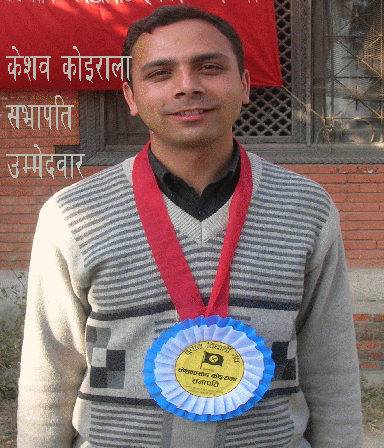
Recently, we have interviewed a candidate of president of FSU from NSU,Mr. Keshab Prasad Koirala of Balmiki college which is affiliated with MSU said that this election is the right place to issue the problems of the students and for their solutions.He said that he is ready to solve every kinds of problems amongs the students if he is selected for the post.

Monday, February 20, 2006

TRANSPORT ENTREPRENEURS WARN OF FARE HIKE


Two day after the rise in prices of petroleum products, transport entrepreneurs have warned that they will be compelled to hike transportation fares if the government did not fulfill their demands immediately.
Speaking at a programme in the capital on Sunday, they served a three-day ultimatum to the government to either revoke its decision to hike the price of petroleum products or increase transport fares accordingly.

President of the Federation of Nepalese National Transport Entrepreneurs (FNNTE), Yogendra Karmacharya, said the entrepreneurs have been bearing losses since the government increased the price of diesel and petrol six months ago. “Now we cannot wait anymore,” report quoted him as saying.
Vice-president of the Federation of Nepalese Transport Entrepreneurs (FNTE), Tulsi Ram Maharjan, said they have decided to hike the fares for short distance routes by Rs 2. “We have been called by the Ministry of Labour and Transport Management (MoLTM) tomorrow at 2 p.m. to discuss the matter,” he said.
However, MoLTM spokesperson said there was no decision on the issue of fare hike as the office remained closed on Saturday and Sunday.
On November 7, the Fare Review and Recommendation Committee had suggested the government to hike transport fares by 12 and 15 percent respectively for long or medium routes and short or local transportation. Likewise, the committee had recommended 16 percent hike in the existing fare of meter taxis.
Meanwhile, transport workers have demanded that the government revoke its decision to raise the price of petroleum products. “The government’s decision to provide monopoly in deciding the price of petroleum products will cause much difficulty to the people,” stated a release issued by the Independent Transport Workers’ Association of Nepal (ITWAN).
Following permission from the government, the Nepal Oil Corporation (NOC) on Friday announced increase in the fuel price. The NOC has allowed private dealers to fix the price of petroleum products sold from outlets